On his podcast, he speaks to nursing home residents living on $72.80 a month
By Aprell May Munford
MassLive.com, September 13, 2026
NORTHAMPTON — For nearly two decades, Massachusetts nursing home residents on MassHealth have had less than $75 a month to spend on personal needs, from toiletries to an occasional treat with their families.
Hoping to build support for an increase, Noah Daube-Valois, a Vassar College student, launched the $72.80 Project, a podcast featuring residents, elder care advocates and information on how listeners can contact their lawmakers.
The idea grew out of a summer spent coordinating activities for residents at Rockridge Retirement Community in Northampton. But Daube-Valois’ connection to the facility began years earlier when he volunteered there as a pianist at age 16.
“I fell in love with the place,” the 20-year-old said during an interview.
A few years later, Daube-Valois became an activity assistant, a role he held for over two years.
It was while taking residents on a recent shopping trip, he began to understand the financial challenges many faced.
Many residents spent their lives working and paying into the system before entering nursing homes, and it was surprising to learn how little money they were able to keep for themselves after paying for their care, he said.
The state’s Personal Needs Allowance, the monthly amount MassHealth recipients living in nursing homes and rest homes can keep from their income for personal expenses, has remained at $72.80 a month, or about $2.40 a day.
It has been that way since 2008, he said.
Daube-Valois said that during one of his most recent outings, several residents asked to stop at Dollar Tree because they could no longer justify spending an extra dollar or two at Walmart.
Another resident became emotional while describing how the monthly allowance left him unable to afford outings with his grandson after covering his personal care needs, he said.
“When our elders are forced to ration basic dignity in one of the wealthiest states in the nation, policy has failed. I created this podcast to spark a multi-generational fight for the right thing to do,” he said in a statement.
Daube-Valois said he was surprised by how few people knew about the allowance. “What I have been met by was, ‘Wow that’s crazy. I had no idea,’” he said.
He was also struck by how little it would cost to increase the allowance. While the state budget totals tens of billions of dollars, raising the personal needs allowance would cost about $15 million, he said.
“So not even a fraction of a percent,” he said. “Nobody would feel the impact, except if you’re a senior and you are struggling to get by.”
He believes a lack of urgency on Beacon Hill has contributed to the allowance remaining unchanged for nearly two decades.
“The people that this issue affects have very little political power,” he said. “We need to call an emergency session and that’s simply not what they’re doing.”
He is not alone in pushing for an increase.
Raising the allowance is a key priority for the advocacy group Dignity Alliance Massachusetts, said former state Sen. Richard T. Moore, chair of the legislative workgroup for the alliance.
“Noah’s podcast brings human faces and lived experiences to numbers on a budget sheet,” Moore said. “It’s past time for the Legislature to restore basic financial dignity to our most vulnerable residents.”
The alliance and Daube-Valois hope the podcast will help gather support of three bills pending in the Massachusetts Legislature that would increase the monthly allowance to $100 and link future increases to inflation.
While increasing the allowance would still leave Massachusetts below some other states, including Alaska ($200), Nevada ($163), and Florida ($160), it would be a meaningful step forward, he said.
Advocates estimate the allowance would exceed $113 a month today if it had kept pace with inflation over the past 18 years, the alliance said in a statement.
The project is just as much about gratitude for the older adults Daube-Valois has worked with, whom he calls family, as it is about advocacy.
“I hope that I can pay a little bit of what they’ve given to me back to them,” he said.
He also hopes the podcast shows that individuals can make a difference on issues they care about.
“Too often, especially young people, look at the political system we live in and think that it’s hopeless and there’s nothing that we can do,” he said. “By starting a project like this, I would like to disprove that.”
Daube-Valois said among the first people he shared the podcast with was his grandparents, who are proud of the project. Unlike many of the residents he interviewed, they are financially secure in retirement, he said.
But memories of his other grandparents, who have since died, also inspired the project.
He described them as working-class people and recalled how his grandmother spent her final months in a Massachusetts nursing home, where she faced many of the same financial struggles as the residents featured in the podcast.
Advocates estimate the allowance would exceed $113 a month today if it had kept pace with inflation over the past 18 years, the alliance said in a statement.
The project is just as much about gratitude for the older adults Daube-Valois has worked with, whom he calls family, as it is about advocacy.
“I hope that I can pay a little bit of what they’ve given to me back to them,” he said.
He also hopes the podcast shows that individuals can make a difference on issues they care about.
“Too often, especially young people, look at the political system we live in and think that it’s hopeless and there’s nothing that we can do,” he said. “By starting a project like this, I would like to disprove that.”
Daube-Valois said among the first people he shared the podcast with was his grandparents, who are proud of the project. Unlike many of the residents he interviewed, they are financially secure in retirement, he said.
But memories of his other grandparents, who have since died, also inspired the project. He described them as working-class people and recalled how his grandmother spent her final months in a Massachusetts nursing home, where she faced many of the same financial struggles as the residents featured in the podcast.
Noah Daube-Valois
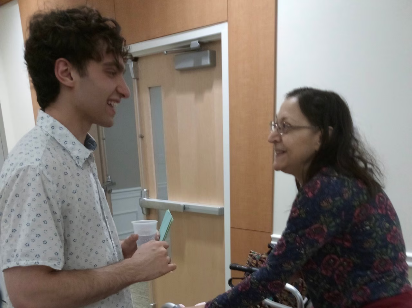
Daube-Valois hosts a podcast to highlight how residents live on $72.80 a month in nursing homes.
Courtesy Photo: Noah Daube-Valois speaks to Jean Smith, a resident of a nursing home in Northampton.